
I'm Cole, a multidisciplinary designer with experience in game design, instructional design, and narrative design. If you're just looking to get a quick glance over my skills and professional experience, please check out my resume and get in touch by email, on bluesky, or via LinkedIn. I hope to be hearing from you soon!
If you want to look at some cool games rather than hear about corpo projects, feel free to skip down to the fun stuff. However, if you're interested in a more thorough review of my work experience...

I know I can! In fact both myself and my previous dev team are legally obligated to! My job as an Experience Designer alongside the immersive team at Deloitte came with a handful of requirements that make the process of actually showing you that work damn near impossible. Nearly all of our clients were various U.S. government agencies who published our projects within private, secure environments (sometimes even deployed within a S.C.I.F.) with zero public access, coverage, acknowledgement, or awareness. Very unfortunate circumstances if you happen to be assembling a portfolio </3.
So here's the plan! I'll show and tell you what I can, when I can, without getting into hot water with a handful of scary three-letter agencies. A couple disclaimers:
- I've elected not to hold a U.S. DoD security clearance due to their lifelong pre-publication review requirements. While this is a firm position at time of writing, I can be convinced otherwise if there have been procedural and legislative changes, or if there's a really, really good reason for it.
- Despite not holding a security clearance, many projects I worked on still contained content labelled as CUI (Controlled Unclassified Information) or FOUO (For Official Use Only). Both are no-go zones and I'll be doing my best to talk around them.
- This list of projects below is non-exhaustive and non-linear. During my time at Deloitte I worked on many projects that I won't be delving into on this page, and our team frequently revisited completed projects for long-term support and updates.
Project 1: Agency Orientation

Starting with the biggest project(s), as well as the only ones with scant public documentation on the NTSA website from a talk given at iFEST 2022! (For context, our team was the "partnering with industry" being referred to toward the end of the iFEST presentation summary shown here) This was a huge, multi-year project all focused around improving the orientation experience for new talent to the agency. During my time working on the initiative, I designed and refined a diverse handful of experiences for the agency alongside the Deloitte immersive development team. Those include the following:
1A: Model Agency Simulation

The Project: An in-classroom roleplaying/simulation activity that taught and modeled the collaboration and interoperability of the agency's internal departments. Students are assigned to one of the handful of agency directorates that each have unique responsibilities within the organization and then complete tasks in line with those responsibilities. Participants exchange tokens representing intelligence and resources with the other directorates as well as collaborate with teammates within their assigned directorate.
My Role: Experience Design & QA. I was tasked to take a second pass at the existing materials and instructions, then as the phase of work progressed I transitioned into managing tests and documenting their outcomes for further revisions. The agency simulation activity had already been delivered and implemented before my time on the project, but the client had identified some pain points and decided to return to us for additional support.
From their feedback, I identified a handful of usability bottlenecks for us to smooth out for them; namely, usability for facilitators, task clarity for participants, and the scoring/reward structure. Facilitators of the activity had a tendency to ignore or overlook instructions for the simulation, which had considerable knock-on effects for the activity as a whole. To combat this, I revised our existing facilitation materials alongside our visual designers to make them more direct and straightforward, adding simple evaluation rubrics to make managing the activity's physical materials much easier. I also worked together with our visual designers to refine and unify the physical tokens used in the activity, which helped learners recognize when and how to use them in different tasks. I also designed and proposed a handful of different solutions to the existing scoring structure for the activity, however the client chose not to move forward with those specific changes in favour of allowing their facilitators to improvise point distributions themselves according to each individual class of learners.
1B: Virtual Facility Tour

The Project: A virtual reality tour of two client facility interiors presented alongside an audio tour featuring supplemental details and history about different features and areas within each location.
My Role: Experience Design & QA. I spent the majority of my time on this project focused on the user experience of the audio tour. Our target users were mostly unacquainted with Virtual Reality and Augmented Reality interfaces, which was a common challenge for a majority of our VR/AR projects. I wireframed a very simple worldspace UI solution to control audio playback and enable gentle teleport navigation between tour stops, then worked with our engineer to implement it within a blockout of the environment while our 3D artists refined the interior layout. Once the interface and tour flow was fully implemented, I shifted into late-project QA to ensure each of the stops functioned properly and the pace of the tour aligned with our client's expectations and feedback. (Fun fact! If you somehow manage to lay your eyes on this project, there should be two golden ducks hidden within the environment courtesy of our awesome 3D artists <3.)
1C: LMS Onboarding Course

The Project: Our client wanted us to revise an existing introductory e-learning course with fresh content and redesign the user flow for increased learning engagement. They noted a tendency in the past for learners to skim and skip their way through the content as quickly as possible rather than properly ingest the information, and wanted our help designing a more engaging format for the course. A very straightforward request!
My Role: Instructional Design & Captivate Implementation. My first role was to present options for a revised user flow through the course using New Captivate from Adobe, which was the only approved platform available for us for this project. I prototyped and presented a handful of options including a narrative-forward presentation of the content, a website wiki-style self-guided exploration of the content, and a punched-up traditional learn-and-quiz flow. The client settled on the self-guided exploration to align with the general motivation and learning styles of their students. With the design phase largely complete until we were able to conduct outcome testing with real users, I shifted roles to implementing those designs in Captivate while our visual designers tackled the various web page stylings, assets, and infographics requested by the client.
Content validation and implementation was a long and arduous process client-side and required many, many revisions to the project before final delivery. I chose to spend some of the downtime during approval waiting periods to refactor the existing Captivate project into a more scalable and flexible framework which made implementing content as it rolled in much easier once we were late into the development cycle. Ultimate delivery was received very well by the client, including and especially the restructuring of the content for greater depth of user engagement.
Project 2: Virtual Reality Training

The Project: The client agency wanted to explore the educational potential of a fully immersive training application. They gave us a specific, soft-skills scenario to focus on and gave us a lot of creative freedom in how we wanted to accomplish that within the virtual reality design space. A huge challenge within this project was that despite being given a handful of specific situations to emulate, the criteria by which users would be evaluated was classified. So we had more than enough information to construct an experientially realistic scenario, but when it came to designing a system to evaluate their performance, give feedback, and reinforce desired behaviors, we wouldn't be able to personally tune the feedback or rewards. We were functionally asked to design a test to which we ourselves we not permitted to know the answers. Quite the challenge.
My Role: Experience Design Lead & QA. I was permitted a significantly extended discovery period for this project, allowing me to collaborate with the rest of the team on our design approach ahead of a proper development phase. I eventually arrived at leveraging self-evaluation and multi-user functionality as a solution to our key design challenge. Even if we were allowed some knowledge into the criteria used to evaluate the client's staff, we would still lack nuance regarding those users and their performance. We designed a system to allow users to re-watch and review their activity within the scenarios, as well as enable instructors to watch users either simultaneously or asynchronously (for reference, picture the classic Halo / Starcraft II match replay system, but applied to roleplaying within a virtual reality social environment like VRChat). This way both the learners and instructors could observe, retry, and re-evaluate their performances better than any rigid system of evaluation we could design from the outside.

To compliment this approach, I also designed for a high level of replayability within the scenario framework. It was easy to take each individual scene and add small sequences with lots of of room for variable random events to ensure that users could play through a single scenario many times before exhausting its educational usefulness. Since this whole design was a fairly complex pitch, I worked closely with our visual artists to create a series of high-fidelity storyboards and wireframes to properly explain the approach to our client, which they were very receptive to. Development proceeded very smoothly through to delivery, and the final product was received with high praise from the client. Some months post-delivery our team had the opportunity to meet with one of the stakeholders on this project, who noted their considerable satisfaction with how the product was performing within their training program.
Project 3: Agency Promotional Mobile Game

The Project: A fun-forward mobile game about the client's agency and the kind of work typical for an analyst there, intended to promote awareness of the organization and get young people interested in a position at the agency as a potential future career. Our team had previously created a proof-of-concept prototype for this client, which they now wanted to flesh out into a full product. This project did undergo some client-side turmoil regarding securing internal approvals for demographic user testing, which our team considered a necessity for this type of explicitly promotional product. While our team did deliver the finished product to the client, to my dismay it was never published or deployed to a public platform </3.
My Role: Game Design Lead, Narrative Design, & Level Design. I had the opportunity to wear a lot of hats and stretch a lot of different design muscles on this project. Starting from the existing prototype, I got to build out a series of mini-games that mechanically represented some of the different analyst responsibilities within the agency. Once the mini-games were implemented, I worked alongside one of the other designers to structure a couple dozen levels in total across each of the distinct designs. In between working on the levels, I wrote a campy carmen-sandiego-esque script that unified the mechanics of each mini-game level together into a simple plot progression while hitting all the educational beats our client wanted to touch on. The script ended up being a solid hit with the client stakeholders, and was well-received during our limited demographic testing.
Whew, that was a lot! Thank you very much for taking the time to read this far through everything. If you want to know further details about the above work, please reach out. I would love to talk with you about my time at Deloitte, it was a very interesting position!
Independent Work (The fun stuff)

Set in the wonderful world of Eberron created by Keith Baker, The Mourning Outpost of Cyre is a (silver‑medal bestselling) mini-dungeon one-shot adventure set in the Mournland, a magical wasteland created in the wake of a recent arcane catastrophe. I made this little adventure to serve as a simple introduction to what I consider to be one of the more underrated portions of the setting. The adventure itself is intended to be used as a hook into further intrigue, rather than attempting to deliver on a full arc all by itself. The main reward of the adventure is not a specific item or gold, but rather a sizeable favor from Pendergast d'Cannith, a loyal emissary of the powerful House Cannith who could prove to be a powerful entry point for an adventuring party into the factional intrigue of the region.
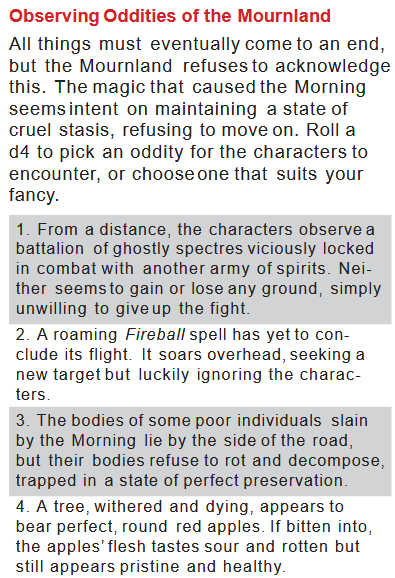
A specific technique I wanted to explore in this adventure was using random tables as worldbuilding and texture for the area they apply to. The Mournland in Eberron is a deeply weird and magical place, and I wanted to express that to a GM reading through the adventure without needing to lean on heavy, prescriptive box text. I wanted to exemplify the idea that if any option within a random table could be true, then all of them must be true and descriptive to the setting as a whole. Even if only a single option from the table ends up being described by the GM to the players, the surrounding options can help inform the GM as to what's possible within the setting and the world, enabling them to further improvise and adjudicate as their game continues.
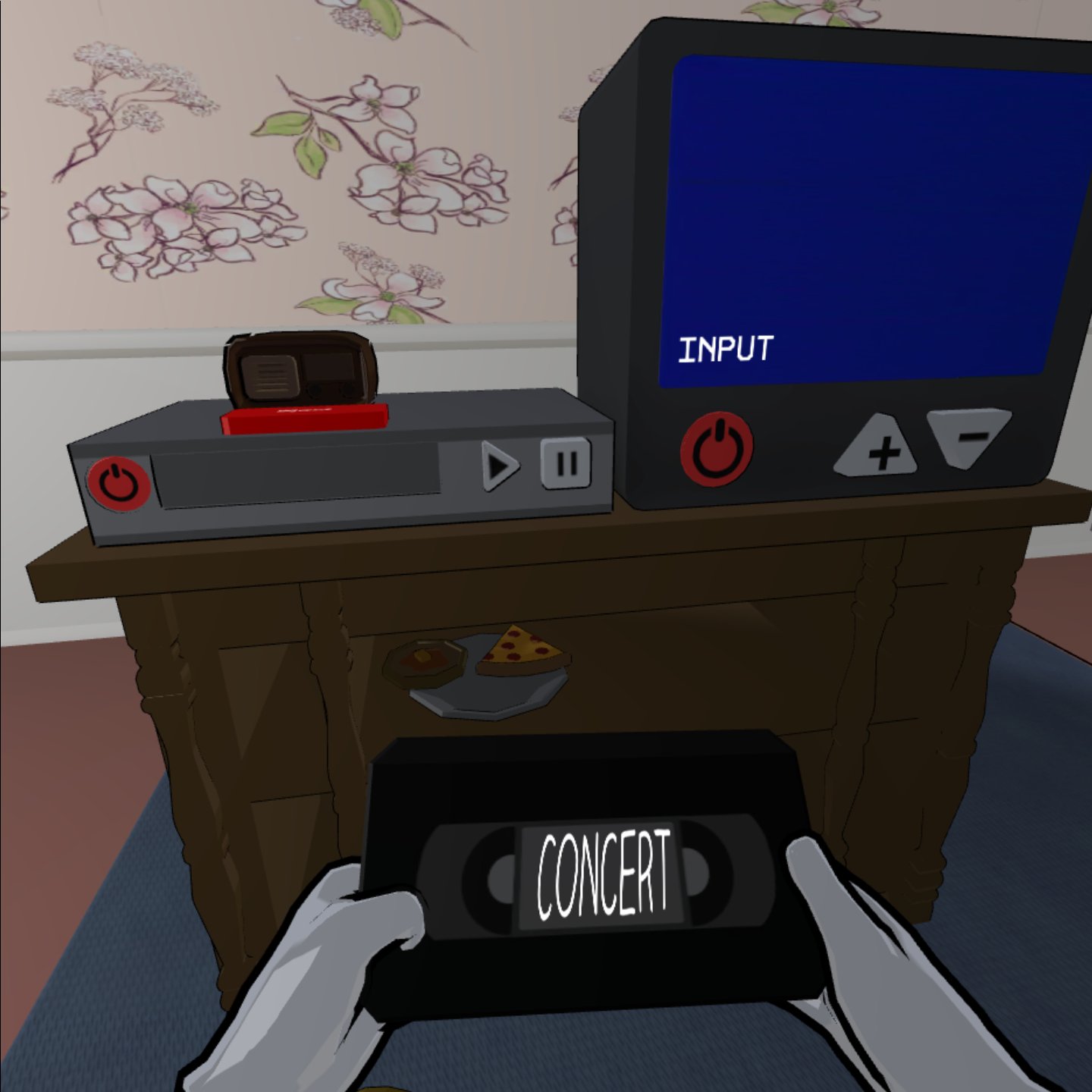
Available on Itch.io as well as directly sideloaded through SideQuest! Weekend at Grandma's is a wholesome little Virtual Reality game where you help your grandma get her VCR hooked up so you can watch some home movies together! It's a simple puzzle slotting each of the cables into the right ports and turning the TV to the appropriate settings before sitting back and watching some VHS tapes! As a joke we thought it would be very funny if putting other objects into the tape slot also showed videos, so we gave every movable prop in the room a unique video as long as you could shove it into the VCR's slot.
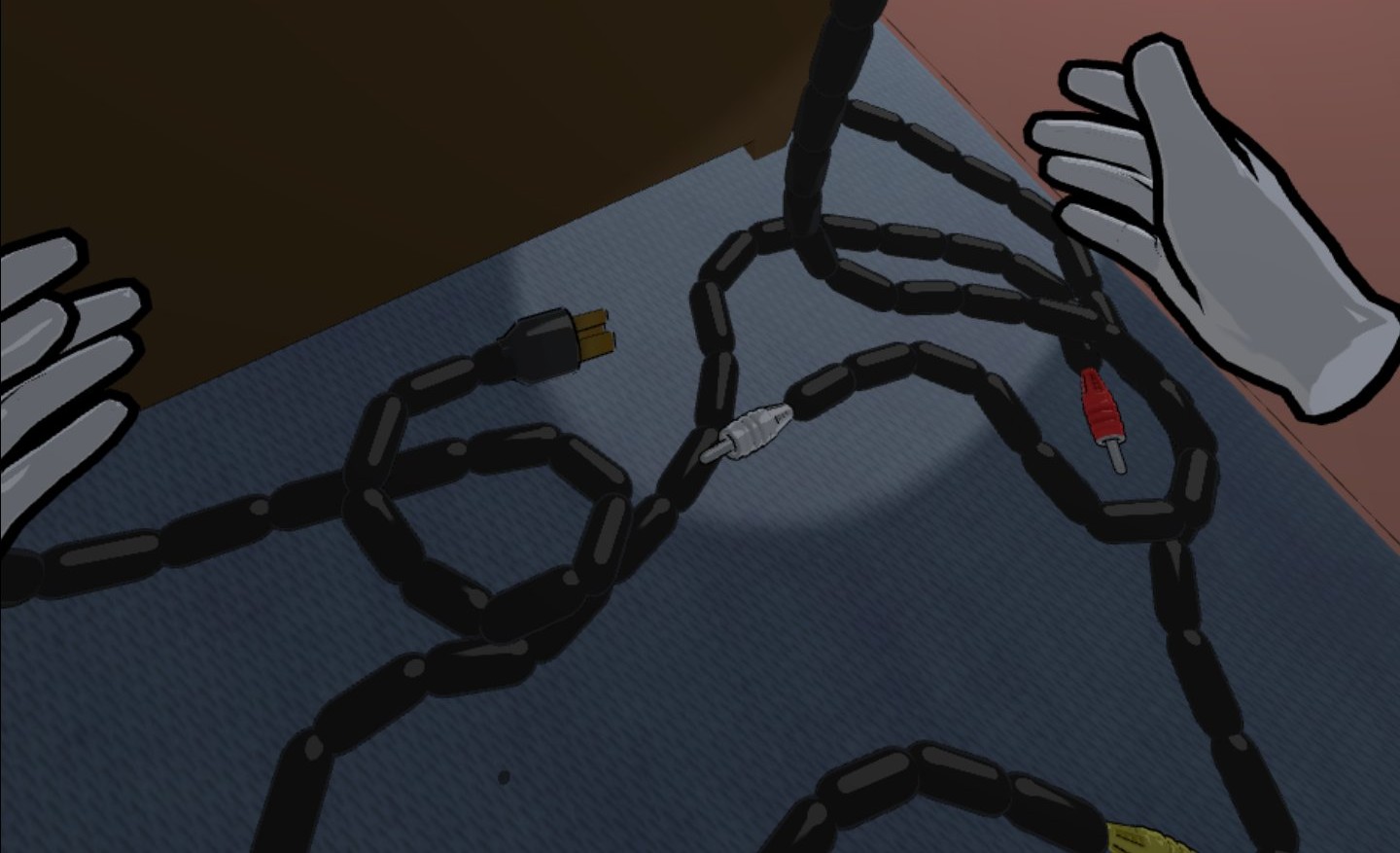
Each playthrough starts with a mess of cables on the floor...
And eventually ends up with everything plugged in nice and neat.
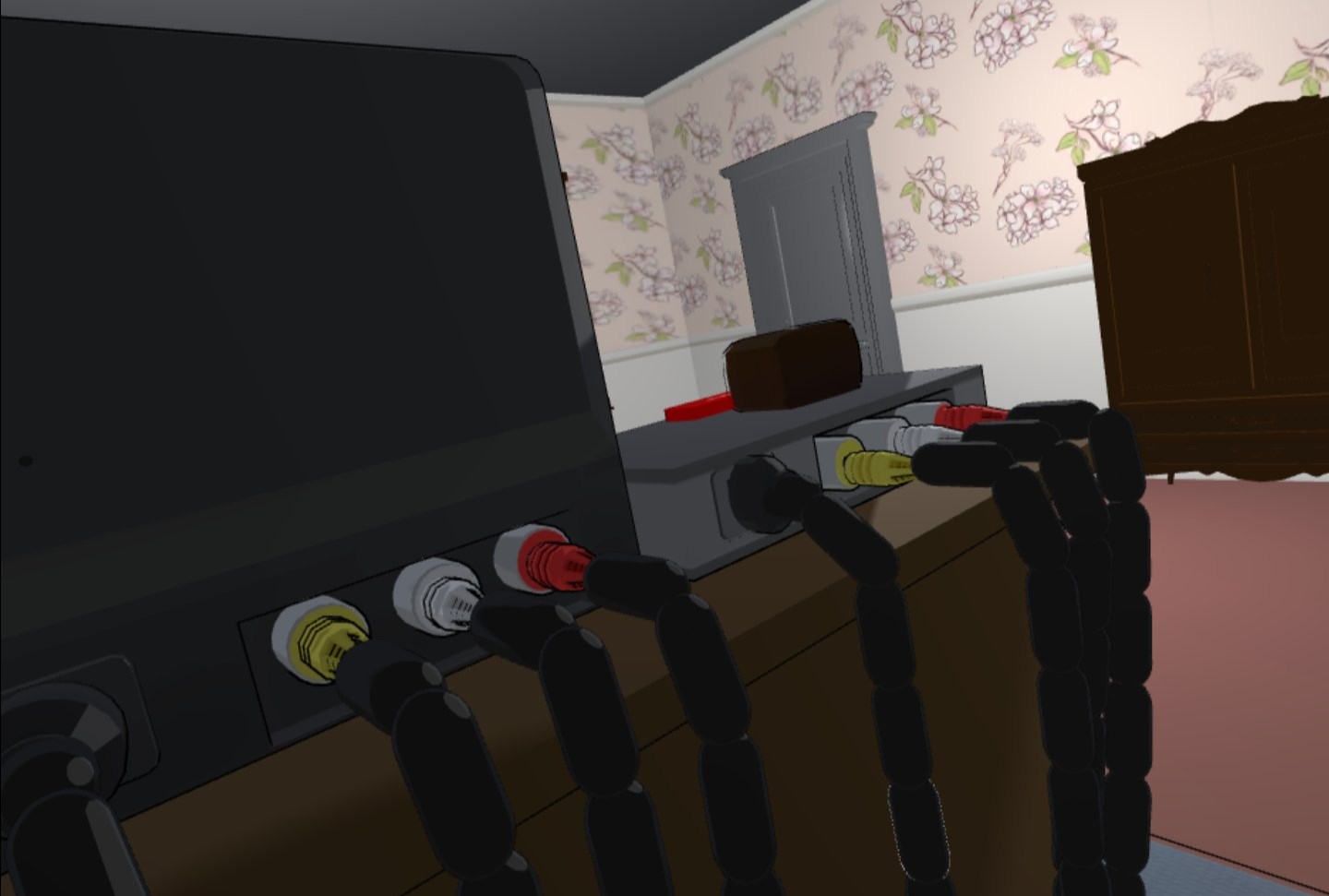
I spent most of my time on this project scripting the device behavior for the VCR and TV. We decided to simplify a lot about both device's interfaces so that the interaction was an intuitive puzzle rather than a strictly accurate emulation of how a VCR and CRT TV work. That said, I did want them to behave very predictably for people who are, in fact, familiar with the arcane box that is a VCR, so we used a couple very simple state machines to manage the behavior of both. This meant that it would perform as expected if only certain cables were attached, e.g. only audio in/out or only video in/out. The small details ended up making a big impact in practice, lots of our players appreciated the attention to detail and tactility of all our big chunky buttons and cables, useful for fumbling VR hands.
This was the first project made by Grandma's Favorites, a small game development team put together toward the end of our time in college together. Many of the home movies featured in the game are from the team's personal collection of handy cam videos. I co-designed this project alongside Parker Hamilton and Justin Carpentre after a long Thanksgiving weekend at my own grandma's house and the team put together the whole thing in just a couple of months before we had to move on to other projects.
An isometric, trap-laying, cart-racing, local-multiplayer frenzy! A twist on emulating the frenetic feel of gas-powered off-road RC car racing with the added chaos of a trap-laying phase, this was a personal design pitch of mine that the rest of our team adopted for prototyping! Our two major references for the design were Ivan "Ironman" Stewart's Super Off Road arcade cabinet and the couch classic Ultimate Chicken Horse. We built and refined our prototype over the course of about seven weeks between our other classes and university capstone projects.
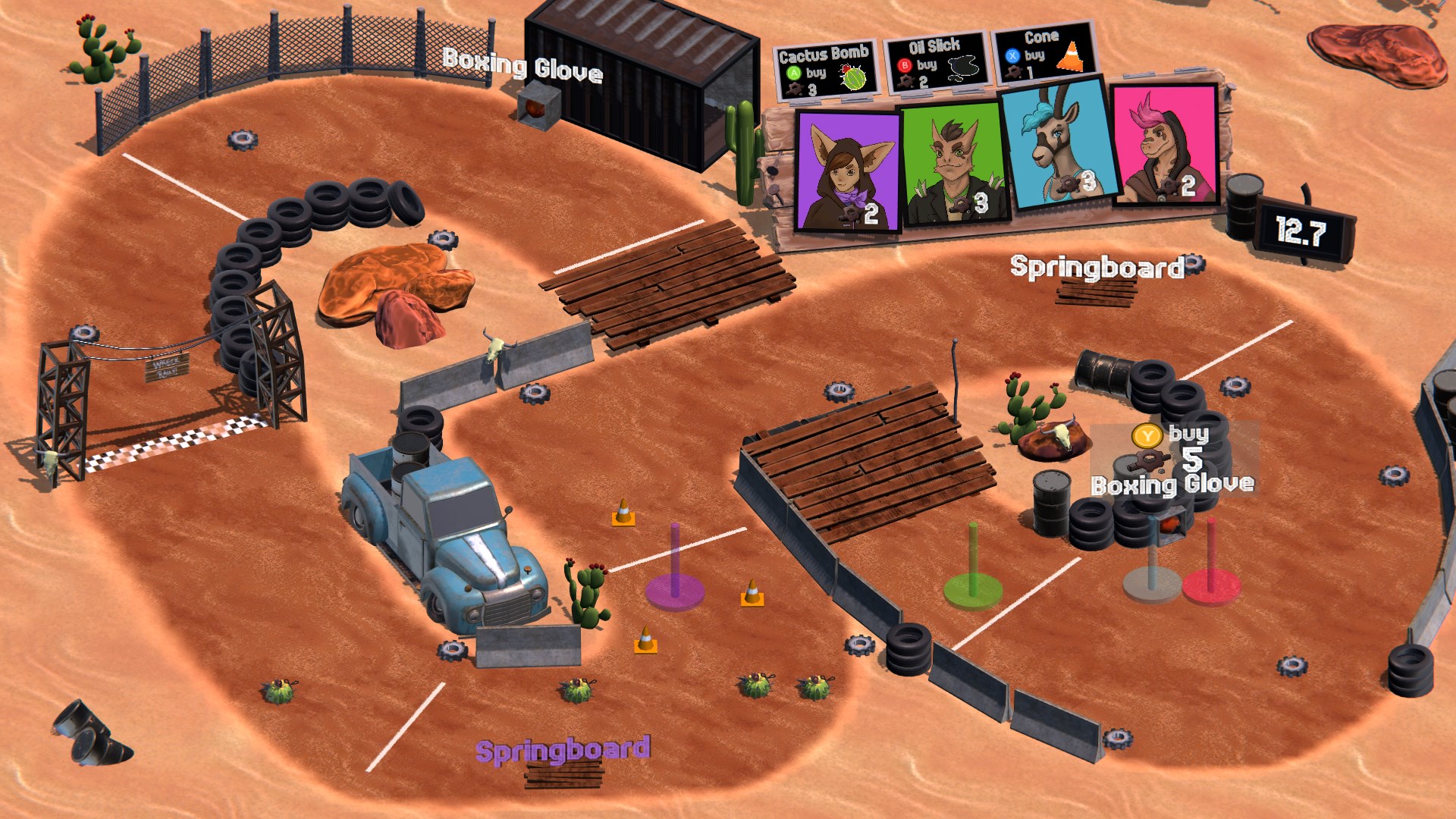
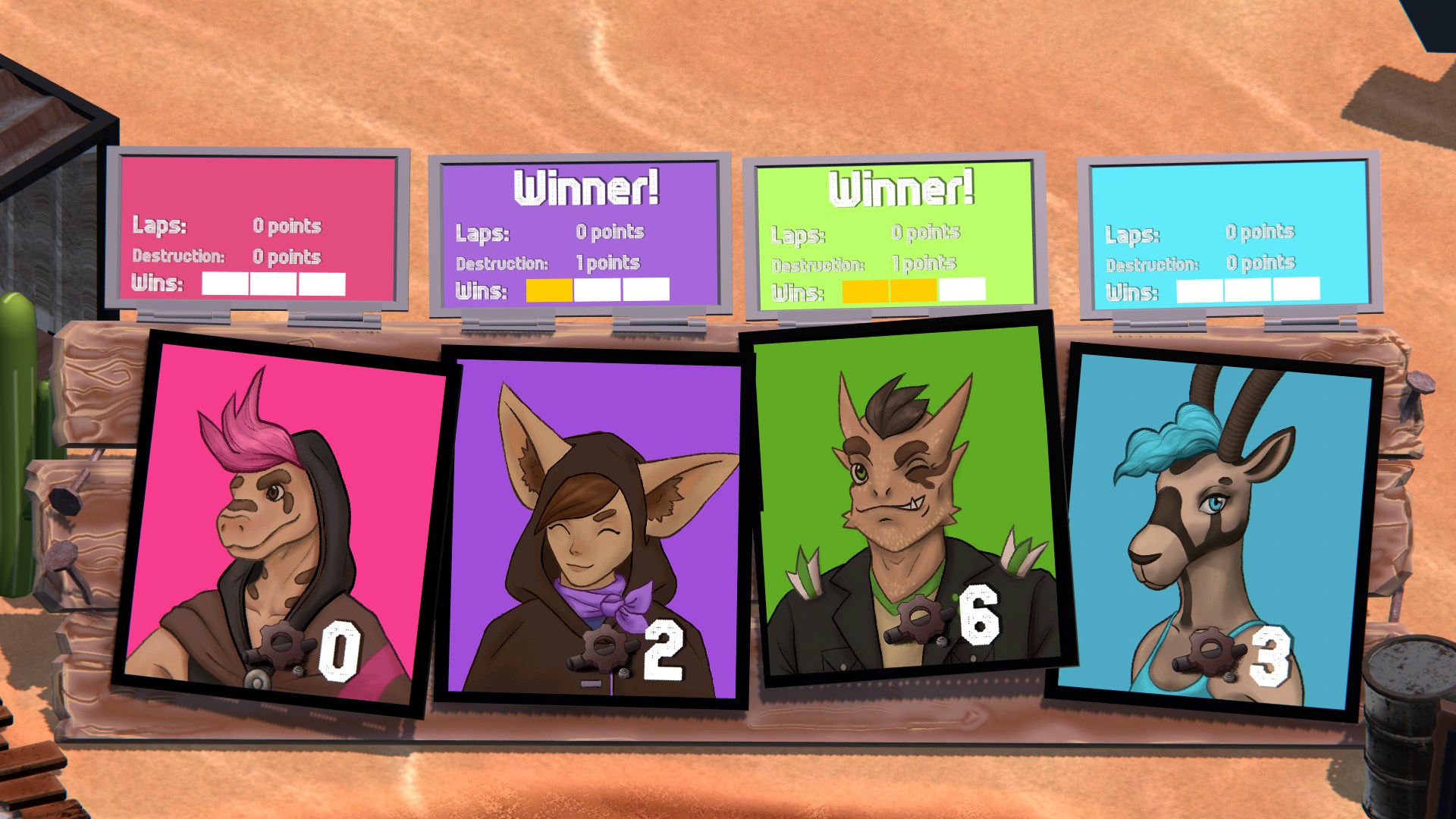
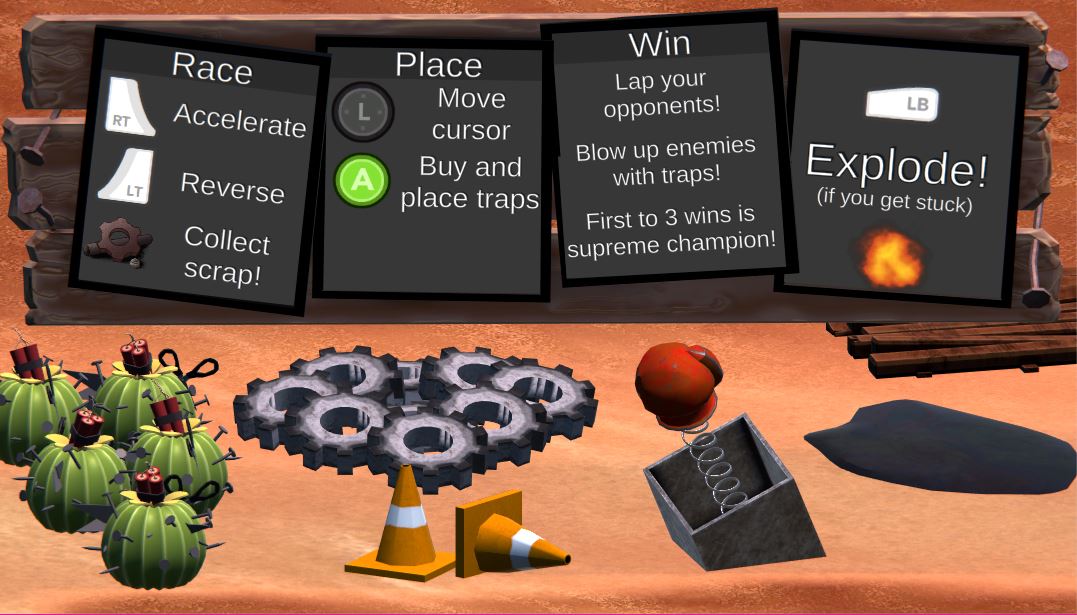
I took lead on implementing the RC car physics and course layout in Unity while the other designers picked up the trap and obstacle designs. We made a pretty big shift in the middle of development from a true perspective camera (emulating the point of view of an RC course racer) to a much more readable isometric perspective ala older arcade racers. This whole project was very much a found-fun style of development; we built a functional version of the concept in a very short amount of time, then tested and refined it through as many iterations as we possibly could in the limited amount of development time we had available. I'm very proud of what we managed to put together, but development was heavily effected by the oncoming pandemic in early 2020.
That's the end of my older work! If you're hungry for more, head over to my active projects page and keep an eye on the blog for more current posts and updates.